

The Best Piercings for Your Face Shape: Expert Placement & Style Guide
Your face shape plays a major role in determining which piercings will enhance your natural features rather than work against them. Just as certain hairstyles or earrings complement specific face shapes, facial piercings follow the same principle. The right piercing placement can create visual balance by either adding length to round faces through vertical piercings like septums and medusas, or adding width to narrow faces with horizontal placements such as snake bites.

Choosing piercings that suit your face shape goes beyond simply picking what looks trendy. Understanding whether you have a round, oval, square, heart-shaped, or long face helps you select placements that work with your bone structure and proportions. A nostril piercing might beautifully accent an oval face, whilst a bridge piercing could add striking drama to angular features.
This guide breaks down the best facial piercings for each face shape, covering everything from pain levels and healing times to jewellery selection and professional aftercare. Whether you’re considering your first piercing or adding to an existing collection, you’ll learn which placements flatter your unique features and how to avoid combinations that might throw off your facial balance.
Key Takeaways
- Vertical piercings like medusas and septums add length to round faces, whilst horizontal placements like snake bites widen narrow faces
- Oval faces can suit nearly any piercing style, making them the most versatile face shape for experimentation
- Professional piercer consultation and proper aftercare with implant-grade titanium jewellery ensure safe healing and long-lasting results
Understanding Face Shapes and Piercing Strategies

Your face shape determines which piercing placements create balance and which ones emphasise features you might want to soften. Bone structure dictates how jewellery sits and how it interacts with your natural proportions.
How to Identify Your Face Shape
Pull your hair back and look straight into a mirror. Trace the outline of your face on the mirror with a washable marker or take a photo to examine your proportions.
An oval face has balanced proportions with a slightly wider forehead than chin. A round face has similar width and length measurements with soft, curved edges. Your square face shows a strong jawline with forehead, cheekbones, and jaw roughly equal in width.
A heart face features a wider forehead that tapers to a narrow, pointed chin. The diamond face has the widest point at the cheekbones with a narrow forehead and chin. An oblong face (also called a rectangle face) is noticeably longer than it is wide with a straight cheek line.
Measure from your hairline to chin, then from cheek to cheek at the widest point. Compare these measurements to confirm your shape.
Why Face Shape Influences Piercing Choices
Horizontal placements widen whilst central placements lengthen your face visually. A nostril piercing draws the eye to the centre, making a round face appear longer. Snake bites create width across a narrow oblong face.
Your bone structure creates natural focal points. Piercing styles that work against your proportions can make features appear unbalanced. A bridge piercing on a long face adds horizontal emphasis that shortens the appearance, whilst the same placement on a round face draws unwanted width.
The goal isn’t to hide your face shape but to choose piercing placements that enhance your natural features. Strategic placement creates symmetry where needed or adds deliberate asymmetry for visual interest.
Working with Your Bone Structure
Your cheekbones, jawline, and brow ridge determine how jewellery rests against your skin. High cheekbones suit placements that don’t compete with this feature, like a subtle nostril stud rather than dramatic cheek piercings.
A strong, angular jaw pairs well with softer piercing styles such as a Monroe or Madonna placement. These create contrast without adding more angles. A delicate bone structure handles dainty jewellery better than chunky statement pieces that overwhelm your features.
Surface piercings like the anti-eyebrow require sufficient flat space on your bone structure. Your piercer assesses whether you have adequate anatomy for specific placements during consultation.
Piercings to Flatter Round Faces

Round faces benefit most from piercings that create vertical lines and add angles, helping to elongate softer features. Strategic placement and slim jewellery choices work together to balance the width of full cheeks without overwhelming your natural shape.
Vertical and Elongating Placements
Your goal is to draw the eye up and down rather than side to side. A septum piercing creates a clean central line that subtly lengthens your face, whilst a vertical labret adds a strong vertical element from your lower lip to chin.
High nostril placements sit closer to the bridge of your nose and pull attention upward. You can wear a single high nostril or choose a mirrored pair for balanced symmetry.
For ear piercings, a forward helix stack with two or three small studs creates an upward climb. An industrial piercing adds a crisp diagonal angle that brings definition to your profile. A rook piercing sits vertically inside the ear’s upper curve, offering a lengthening effect without adding width.
Stacked lobe piercings arranged in a neat vertical column also work well. These face piercings complement your unique facial features when placed thoughtfully.
Recommended Jewellery and Styles
Keep your piercing jewellery refined to maintain proportion. For a nostril piercing, choose a nose stud between 1.5 and 2.5 mm in teardrop, marquise, or oval shapes. If you prefer hoops, select snug rings with an 8 to 9 mm diameter.
Septum jewellery should feature thin clickers or horseshoes, typically 8 to 10 mm inside diameter. Avoid oversized gems or wide rings that add horizontal bulk.
For helix piercings and forward helix stacks, micro studs work best. Select flat-back labrets with simple tops in implant-grade titanium or 14-carat solid gold.
Drop earrings can work if they create a vertical line rather than sitting wide at the sides. Stick to petite curved barbells for rook piercings and tight hoops or flat studs for conch placements.
Balancing Full Cheeks
Your cheeks are likely the widest point of your face, so choosing the right piercing for your face shape means avoiding anything that emphasises horizontal width.
Centre your piercings where possible. A philtrum piercing sits in the cupid’s bow and creates a focal point that balances cheek fullness. Paired high nostrils flanking your nose bridge offer symmetry without adding side width.
Be mindful of multiple horizontal piercings placed at the same level. Instead of several side-by-side studs, arrange them vertically or diagonally.
Your anatomy matters more than trends. A professional piercer should assess your specific features before placing any piercing. What works on someone else’s round face might need adjustment for yours based on nose width, ear cartilage shape, and lip structure.
Optimal Piercings for Oval Face Shapes
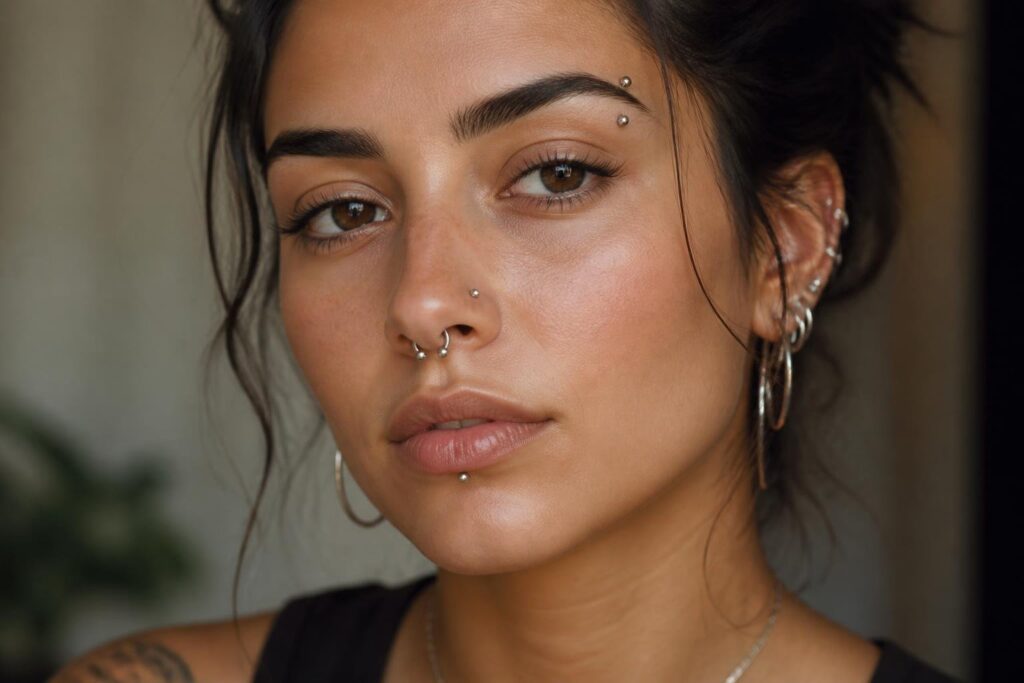
Oval faces offer balanced proportions that work well with most piercing styles, from classic nostril studs to statement cartilage pieces. Your naturally harmonious features allow you to experiment with placement and jewellery without overwhelming your face shape.
Versatile Piercing Options
Your oval face shape suits nearly any piercing placement because your proportions are already balanced. Nostril piercings work particularly well on oval faces, whether you choose a simple stud or plan to switch to a snug hoop once healed.
A septum piercing adds interest to the centre of your face without disrupting your natural symmetry. Many people with oval faces start with a 16 gauge circular barbell measuring 8-10 mm in diameter. This size works for most noses, though your piercer will measure your anatomy for the best fit.
High nostril piercings create a distinctive look that complements your face length. You can also consider double nostril piercings on one side or symmetrical placements on both sides. Your balanced features won’t be overwhelmed by multiple face piercings the way narrower or wider face shapes might be.
Ear and Nose Piercing Ideas
Ear piercings offer excellent options for oval faces:
- Helix piercing: A single stud or small hoop adds visual interest without competing with your facial features
- Conch piercing: Both stud and hoop options work well, with typical starter posts measuring 6-8 mm and healed hoops around 12-14 mm
- Stacked lobe piercings: Two or three placements create a curated look
- Daith piercing: The curved placement suits your proportions
Cartilage piercings generally take 6-12 months to heal fully, so start with a flat-back stud before switching to decorative jewellery. Nostril piercings typically need 4-6 months before you can safely change to a hoop.
For a bolder choice, a medusa piercing in the philtrum (the groove above your upper lip) creates a focal point that works with oval face proportions.
Jewellery Choices for Balanced Features
Your main goal with piercing jewellery is maintaining the balance you already have rather than correcting proportions. Choose pieces that reflect your personal style without oversizing or undersizing.
Metal and size recommendations:
| Piercing type | Starter gauge | Common sizes | Metal choice |
|---|---|---|---|
| Nostril | 18-20 g | 2-3 mm tops, 8-10 mm hoops | Implant-grade titanium (ASTM F-136) or 14k gold |
| Septum | 16 g | 8-10 mm diameter | Titanium or solid gold |
| Helix/conch | 16 g | 6-8 mm post length | Threadless titanium posts |
Keep proportions in mind when selecting gem sizes. A 2-3 mm stone for nostril piercings reads as elegant without dominating your features. Larger statement pieces can work on oval faces, but check the scale in natural lighting before committing.
Delicate chains connecting two ear piercings suit your face shape well. Curved jewellery like clickers and seamless rings maintain visual flow without creating harsh angles.
Enhancing Square Face Structures with Piercings

A square face features a strong jawline, broad forehead, and equal width and length that create bold, angular beauty. Softer, curved jewellery placements work best to balance these geometric features whilst strategic positioning draws attention to your natural symmetry.
Soften Angular Features
Your square face benefits most from piercings that introduce curves and roundness to counterbalance sharp angles. Curved placements help soften naturally structured features rather than emphasizing them further.
A bridge piercing placed horizontally across your nose bridge adds visual interest whilst the curved barbell creates gentle lines. This placement draws eyes to the centre of your face. The rounded jewellery softens the geometric quality of your facial structure.
Avoid very angular or geometric jewellery shapes. Straight barbells and sharp triangular studs will emphasize the squareness you’re trying to balance. Instead, choose circular barbells and curved pieces that introduce flowing lines.
The key is creating visual movement through rounded forms. Your strong bone structure provides an excellent foundation that curved piercings complement beautifully.
Curved and Rounded Placements
Specific piercings work particularly well for square faces when paired with the right jewellery. A nose piercing with a small hoop or curved stud adds softness to your profile. Choose delicate pieces rather than bold studs that might compete with your already prominent features.
Septum piercings suit square faces exceptionally well. A circular barbell or horseshoe ring introduces curves at your face’s central point. You can flip it up for professional settings or display it to add rounded visual interest.
Monroe or Madonna piercings create focal points that break up the straight lines of your jaw. These subtle lip placements work best with small, rounded studs. Snake bites positioned on your lower lip add symmetry whilst the paired placement balances your broad jawline.
The placement of vertical piercings helps elongate whilst curved jewellery softens. This combination creates harmony with your natural structure.
Lip and Ear Options
Your lip area offers excellent opportunities for face piercings that flatter square faces. A medusa piercing centred in your philtrum adds a delicate focal point. The single centred placement works with your facial symmetry rather than against it.
Labret piercings positioned below your lower lip create visual interest without overwhelming your features. Pair these with curved or rounded studs for the best effect.
For ear piercings, choose placements that follow your ear’s natural curves. A daith piercing nestled in your ear’s innermost cartilage fold introduces an elegant curve. The heart-shaped anatomy of this placement provides organic roundness.
Tragus and helix piercings work beautifully on square faces when styled with small hoops or curved studs. Multiple helix piercings arranged in a gentle arc soften your profile when viewed from the side. Stack two or three piercings along your upper ear with delicate hoops that create flowing lines.
Combine ear and facial piercings thoughtfully. Too many angular placements compete with your bone structure, whilst curved pieces in strategic locations enhance your natural beauty.
Piercing Tips for Heart-Shaped Faces

Heart-shaped faces feature a wider forehead that tapers to a narrower chin, creating natural angles that benefit from strategic piercing placement. Lower-face piercings work best to add visual weight below the cheekbones whilst maintaining your face’s inherent balance.
Balancing a Narrow Chin
Your narrow chin needs visual anchoring to create harmony with your broader forehead. A labret piercing sits directly below your lower lip and draws attention downward, which helps balance your proportions. The medusa piercing offers another excellent option by sitting in your philtrum above your upper lip.
Snake bites provide double the impact with two symmetrical piercings flanking your lower lip. This horizontal placement adds width where your face naturally narrows. An Ashley piercing creates a vertical accent through your lower lip itself, offering a bolder statement.
Lower-face piercings like the labret, medusa, and Ashley are particularly flattering for heart-shaped faces. These placements typically heal within 2-4 months and use 16-14 gauge jewellery. Avoid placing multiple piercings near your chin point, as clustering can create an overly heavy appearance rather than balanced symmetry.
Best Ear and Lip Placements
Your ear piercings complement facial work by framing your face shape. A daith piercing sits in your inner cartilage fold and pairs well with a nostril stud for subtle coordination. The tragus piercing creates a focal point near your face without competing with lip placements.
Conch piercings offer versatility through your ear’s central cartilage bowl. These cartilage piercings heal in 3-9 months and work alongside any lip piercing combination you choose. For lip placements specifically, the Monroe or Madonna piercing mimics a beauty mark on your upper lip side.
Cheek piercings emphasise the playful features of heart-shaped faces by highlighting your defined cheekbones. However, these require 8-12 months healing time and carry higher pain levels at 7/10. Consider starting with simpler placements before committing to cheek work.
Facial Symmetry and Jewellery
Your jewellery choices affect how piercings interact with your face’s natural lines. Small, delicate nose rings suit your proportions better than large statement hoops that can overwhelm your features. For a nose piercing, choose a subtle stud in your nostril rather than bold septum jewellery.
Paired piercings require careful spacing to maintain symmetry. Snake bites should sit equidistant from your lip centre, typically 1-1.5cm apart. Angel bites follow similar spacing rules on your upper lip.
Jewellery sizing guide:
| Placement | Recommended Size | Material |
|---|---|---|
| Nostril | 2-3mm stud | Titanium |
| Labret | 6-8mm bar | Titanium |
| Medusa | 8-10mm bar | Titanium |
| Tragus | 5-6mm bar | Titanium |
Use ASTM F-136 implant-grade titanium for fresh piercings regardless of placement. Once healed, 14-carat gold offers elegant versatility across all your facial piercings. Avoid heavy jewellery in lip piercings, as weight can cause migration or damage to your gums and teeth.
Piercings for Unique and Less Common Face Shapes

Not all faces fit neatly into the standard oval or round categories. Diamond, oblong, and rectangle face shapes each have distinct features that benefit from specific piercing placements to enhance natural proportions.
Diamond Face: Accentuating Cheekbones
Your diamond face shape features prominent cheekbones with a narrower forehead and chin. This creates a naturally striking bone structure that piercings can highlight beautifully.
Cheek piercings work exceptionally well for diamond faces because they draw attention to your already defined cheekbones. These create a dimple effect that emphasises your facial width at its widest point. However, be aware that cheek piercings are amongst the most painful face piercings at 7/10 on the pain scale and take 8-12 months to heal.
Lip piercings like labret or medusa styles add weight to your narrower chin area, creating better balance. A medusa piercing sits in the philtrum above your upper lip and draws the eye to the centre of your face.
Nostril piercings on one or both sides soften the angular quality of diamond faces without competing with your cheekbones. You can also try a septum piercing for a centred look that doesn’t overwhelm your features.
Avoid bridge piercings or horizontal eyebrow placements, as these add unnecessary width where your face is already at its broadest point.
Oblong and Rectangle Faces: Creating Width
Oblong and rectangle faces share a longer vertical dimension with less width across the cheeks. Your face shape benefits from horizontal piercing placements that create the illusion of width.
Snake bites (two piercings flanking your lower lip) work particularly well because they draw the eye horizontally across your face. Dahlia piercings at the mouth corners achieve a similar widening effect. These horizontal placements visually widen the face.
Double nostril piercings on both sides create horizontal visual interest. You can wear matching studs or small hoops to emphasise the width-creating effect.
Avoid vertical piercings like the medusa or vertical labret, as these add length to an already long face. Bridge piercings should also be skipped because they emphasise vertical proportions.
Eyebrow piercings placed horizontally can work, though these are trickier to heal and have higher rejection rates than vertical placements.
Curated Ear and Multiple Piercing Styles
A curated ear refers to a carefully planned arrangement of multiple ear piercings that creates a cohesive, personalised look. This approach works for any face shape because it focuses on the ear itself rather than facial proportions.
Cartilage piercings form the foundation of most curated ear designs. Popular placements include the helix (upper ear rim), forward helix (front of the ear rim), tragus, and conch. You can combine these with standard lobe piercings for depth and variety.
Start by choosing an anchor piercing like a statement conch or industrial bar, then build around it with smaller studs or hoops. Space your piercings at least 2-3 months apart to allow proper healing and avoid overwhelming your immune system.
Mixed jewellery styles create visual interest. Pair delicate gold studs with slightly larger hoops, or mix metals if your skin tolerates it. Keep fresh piercings to implant-grade titanium until fully healed.
Curated ears complement face piercings beautifully. If you already have nose piercings or lip piercings, coordinate your ear jewellery to match the metal finish for a polished appearance.
Piercing Jewellery Selection and Professional Advice
The right jewellery material protects healing tissue whilst the correct style enhances your chosen placement. Working with qualified piercers ensures both safety and aesthetic results that suit your face shape.
Best Materials for Sensitive Skin
ASTM F-136 implant-grade titanium remains the safest choice for fresh piercings. This material causes minimal irritation and works for all skin types, even those prone to reactions.
Avoid generic surgical steel during healing. It often contains nickel, which triggers allergic responses in sensitive skin. Sterling silver also causes problems in unhealed piercings due to tarnishing and bacterial growth.
Once fully healed, you can expand to 14-karat gold or higher, niobium, or glass. Gold-plated jewellery should never touch healing tissue. The plating wears away and exposes base metals that irritate piercing channels.
For temporarily hiding piercings at work, PTFE (plastic) retainers work well in healed piercings. These flexible pieces sit flat against skin and come in clear or flesh tones.
Choosing Jewellery to Complement Placements
Different placements require specific jewellery styles. A nose stud works for nostril piercings, whilst a circular barbell suits septum placements that you might flip up to hide.
| Placement | Best Jewellery Type |
|---|---|
| Nostril | Labret studs, L-shaped studs |
| Septum | Circular barbells, clickers |
| Labret | Flat-back studs, rings |
| Eyebrow | Curved barbells |
| Bridge | Straight barbells |
Jewellery size matters for your face shape. Delicate studs flatter round faces by avoiding added width. Larger statement pieces like bold circular barbells balance long or narrow faces by drawing attention to central features.
Match metal finishes to your skin tone. Rose gold complements warm undertones whilst white gold or silver suits cool-toned skin. Titanium comes anodised in various colours if you prefer standout looks.
Working with Professional Piercers
Visit piercers registered with the Association of Professional Piercers for verified expertise. These professionals follow strict safety protocols and use proper sterilisation equipment.
A qualified piercer assesses your anatomy before recommending placements. They identify whether your tissue suits surface piercings or if rejection risks run high. They also suggest piercing placements that flatter your specific face shape.
Ask about jewellery options during your consultation. Professional studios stock implant-grade pieces in various sizes rather than using piercing guns with low-quality studs. They’ll explain proper aftercare and schedule follow-up appointments to check healing progress.
Expect to pay £40-120 for facial piercings at reputable studios. This price includes starter jewellery made from safe materials. Cheaper options at mall kiosks use guns that damage tissue and increase infection risk.
Placement, Aftercare, and Healing Essentials
Proper placement sets the foundation for successful healing, while consistent aftercare prevents complications and ensures your piercing heals correctly. Different facial piercings require specific healing times and maintenance routines based on their location and depth.
Piercing Healing Times by Placement
Healing times vary significantly depending on where you place your piercing on your face. Nostril piercings typically heal within 3 to 6 months, making them one of the faster options. Septum piercings follow a similar timeline at 6 to 8 weeks for initial healing.
Lip piercings, including labret, Monroe, and Madonna placements, generally need 6 to 8 weeks. However, cheek piercings require considerably more time at 8 to 12 months due to the thickness of tissue involved.
Surface piercings like eyebrow, bridge, and anti-eyebrow placements take 6 to 8 weeks but carry higher rejection risks. Your body’s natural healing process affects these timeframes, so some people heal faster whilst others need additional time.
Aftercare Products and Tips
Clean your new piercing twice daily with sterile saline solution. Avoid harsh products like alcohol, hydrogen peroxide, or antibacterial soaps that can irritate the area.
Essential aftercare steps:
- Wash your hands thoroughly before touching the piercing
- Spray saline solution directly onto the piercing site
- Pat dry with clean gauze or let air dry
- Avoid makeup, lotions, and skincare products near the piercing
- Don’t remove or change jewellery during healing
Sleep on the opposite side of your piercing to prevent trauma and pressure. Be cautious when dressing, brushing your teeth, or washing your face to avoid snagging the jewellery.
When to Change or Upgrade Jewellery
Wait until your piercing fully heals before changing jewellery. Switching too early interrupts healing and increases infection risk.
Your piercer will typically install starter sizes made from implant-grade titanium or surgical steel. These materials minimize allergic reactions during the vulnerable healing period. Once healed, you can explore different materials like gold, niobium, or decorative pieces.
Visit your piercer for your first jewellery change rather than attempting it yourself. They’ll confirm proper healing and ensure the new piece fits correctly. Downsizing may be necessary after initial swelling subsides, usually around 4 to 6 weeks for most facial piercings.
Frequently Asked Questions
Face shape analysis requires specific measurements, and different placements create distinct visual effects that either lengthen, widen, or balance your natural proportions.
How do I work out my face shape accurately at home?
Pull your hair back completely and stand in front of a mirror with good lighting. Use a flexible tape measure or even a dry-erase marker to trace your face outline directly on the mirror.
Measure four key distances: forehead width at its widest point, cheekbone width from the outer corner of one eye to the other, jawline width from below your ear to your chin, and total face length from hairline to chin. Compare these measurements to determine your shape.
Round faces have similar width and length measurements with soft angles. Oval faces are about 1.5 times longer than they are wide with gently rounded edges. Square faces have similar width and length but with a strong, angular jawline. Long or oblong faces are noticeably longer than they are wide. Heart-shaped faces are widest at the forehead and taper to a narrow chin.
Which facial piercings tend to suit a round face best?
Vertical placements create length and help balance the soft curves of a round face. The medusa, septum, bridge, and Ashley piercings all draw the eye up and down rather than side to side.
A vertical eyebrow piercing adds height to the upper face. The medusa sits in your philtrum and creates a central focal point that elongates your face visually.
Avoid horizontal placements like dahlia piercings at the mouth corners or snake bites, as these emphasise width. Single nostril piercings work well because they don’t add horizontal visual weight.
What piercing placements help balance a long or oblong face?
Horizontal placements widen your face visually and create better proportions. Snake bites, dahlia piercings, and paired nostril piercings all add width where your face needs it most.
Double nostril piercings on opposite sides create a horizontal line across the centre of your face. Angel bites (paired Monroe and Madonna piercings) do the same for your upper lip area.
A horizontal eyebrow piercing works theoretically, but this placement has high rejection rates of 40-60% according to professional piercing standards. Snake bites offer a safer option that still achieves the widening effect.
Which piercings usually complement an oval face without overpowering it?
Oval faces have balanced proportions, so nearly any placement works well. You can choose based purely on personal style rather than needing to correct facial balance.
Start with classic options like a nostril or septum piercing if you want something understated. These placements enhance your natural symmetry without competing with your features.
You have the freedom to try more dramatic choices like a bridge piercing or cheek piercings if you prefer a bolder look. Multiple combinations also work on oval faces—a nostril paired with a septum creates a cohesive nose focus, whilst a medusa adds elegance to your upper lip.
How can I choose jewellery size and style to flatter my facial proportions?
Smaller, delicate jewellery suits petite features and narrow faces. Larger statement pieces balance wider or fuller faces without getting lost in your proportions.
If you have a narrow nose, choose small-diameter nostril studs (2-2.5mm gems) and tight-fitting septum clickers. Wider noses can accommodate 3-4mm gems and larger circular barbells that fill the space proportionally.
Consider your lip fullness when selecting labret or medusa jewellery. Thin lips look best with smaller disc backs (4-5mm), whilst fuller lips can handle 6-7mm discs. The jewellery should sit flush against your lip without creating bulk or appearing tiny.
What should I consider about symmetry and features (such as nose shape or lips) before choosing a piercing?
Existing asymmetry in your features affects piercing placement more than your overall face shape. A slightly crooked nose or uneven lips require adjusted positioning to maintain visual balance.
Your nose bridge width determines whether a bridge piercing will sit comfortably. Very narrow bridges may not have enough flat surface area for proper placement. Consult a professional piercer to assess whether you have adequate anatomy.
Lip piercings interact directly with your teeth and gums. If you have thin lips, an Ashley piercing may contact your lower teeth constantly and cause enamel damage. A standard labret positioned below the lip creates less dental risk whilst still framing your mouth attractively.